-

-

-

-

-
CopyToClipboard

- Why LTL Is a strategic fit for scaling businesses
- How to manage LTL freight effectively
- Market trends shape LTL strategy
- Do's and Don'ts for LTL delivery
- The AI advantage: A new era for LTL delivery
- LTL as a growth enabler
- Customer spotlight: A success story
As small and medium-sized businesses (SMBs) evolve beyond the startup phase, logistics becomes more than a back-office function, it becomes a strategic advantage. When delivering requirements exceed small parcel capabilities but don’t yet justify full truckload commitments, less-than-truckload (LTL) delivery offers a flexible, cost-effective solution tailored for growth.
With expert-backed strategies and practical insights, supply chain managers and business owners can confidently navigate LTL delivering to streamline operations, reduce costs and improve delivery reliability.
Why LTL is a strategic fit for scaling businesses
LTL delivery consolidates freight from multiple shippers into a single truck, making it ideal for:
- Deliveries under 15,000 lbs
- Regional or multi-zone distribution
- Seasonal or variable delivery volumes
- Businesses expanding into new markets
By sharing truck space, businesses can avoid the overhead of full truckload contracts while maintaining agility and cost control—critical for businesses where every dollar and delivery counts.
How to manage LTL freight effectively
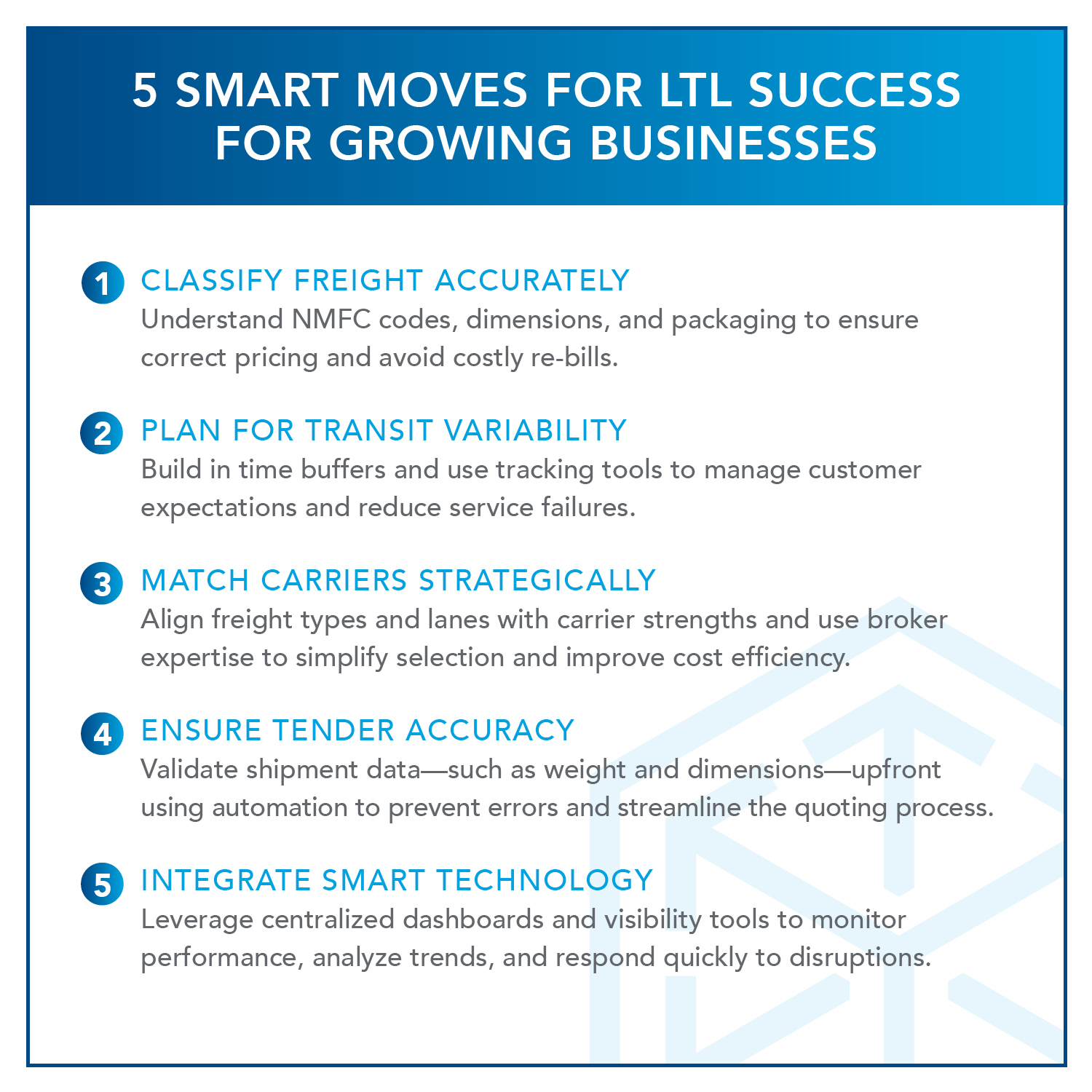
Success with LTL delivery hinges on understanding key operational levers. Here’s what to prioritise:
- Freight characteristics
Size, weight and packaging directly affect pricing and carrier selection. Understanding NMFC classifications and density-based pricing is essential. Misclassification can lead to costly re-bills and delays. For businesses managing a wide variety of freight types, working with an LTL broker that uses AI tools to automate and accurately classify deliveries can significantly reduce errors and accelerate the quoting process, especially when dealing with complex or frequently changing freight profiles. - Transit time expectations
Published transit times are often best-case scenarios. It is important to build in buffers and monitor actual performance to maintain customer satisfaction. Logistics professionals leveraging AI-powered tracking tools can help to identify delays early and suggest proactive solutions, keeping your business moving smoothly and efficiently. - Carrier compatibility
Not all carriers excel in every lane. Match your freight type and regional needs to carriers with proven strengths in those areas. For businesses navigating multiple lanes or freight profiles, partnering with a third-party broker can simplify carrier selection by leveraging data and experience across a broad network, helping ensure the right carrier is matched to the right delivery every time. This strategic alignment not only improves delivery performance but also enhances cost efficiency by minimising delays, optimising routes and avoiding mismatched carrier fees. - Tender accuracy
Inaccurate delivery details (e.g., dimensions, weight) are a leading cause of re-bills and service failures. Leveraging a third-party broker can help streamline this process by validating delivery data upfront and applying automated tools to catch discrepancies before they become costly issues hitting your bottom line. This proactive approach helps protect your bottom line and keeps your operations running smoothly. - Technology integration
Visibility tools, tracking systems and reporting dashboards help manage performance, exceptions and customer expectations. Brokers with integrated platforms can offer centralised access to these tools across multiple carriers, making it easier to monitor deliveries, analyse trends and respond quickly to disruptions. This level of integration not only improves operational agility but also supports cost efficiency by reducing manual errors, optimising carrier performance and enabling smarter decision-making through real-time data.
Market trends shape LTL strategy
Understanding current market dynamics is key to building a resilient LTL strategy. As the LTL sector continues to operate under soft demand and economic uncertainty, carriers are doubling down on efficiency and cost control. These trends are shaping how businesses should approach their LTL strategy today:
- Capacity constraints: Terminal expansion remains slow and seasonal disruptions like hurricanes can cause sudden rate spikes and service breakdowns. Proactive planning and flexible freight strategies are essential.
- Pricing discipline: Despite volume fluctuations, carriers are holding firm on rates. The July 2025 NMFC updates now emphasise freight density, supporting more consistent pricing and better cost alignment.
- Consolidation opportunities: Pool distribution and cross-docking remain valuable tactics to reduce costs and improve delivery speed, especially in low-volume or regional lanes.
Ready to explore smarter LTL solutions?
Request a Quote to connect with a logistics expert who understands the unique needs of growing businesses.
Do you deliver less than 4 times every year?
Simplify LTL delivery across the U.S. and Canada with a 100% online experience at Freightquote by C.H. Robinson.
Do's and don'ts for LTL delivery
Do:
- Diversify your carrier portfolio to mitigate risk and maintain flexibility during disruptions.
- Create strategic pick schedules to minimise dwell time and improve carrier efficiency.
- Use data to analyse freight mix and optimise delivering modes and reduce costs.
- Align internal teams on delivery planning and exception handling.
- Partner with a logistics partner who can co-ordinate across carriers, streamline operations and provide insights that may not be visible from a single-provider view.
Don't:
- Rely too heavily on one carrier or mode.
- Underestimate the impact of inaccurate delivery data.
- Neglect packaging and freight class in pricing.
- Forget to monitor and adjust based on carrier performance.
The AI advantage: A new era for LTL delivery
C.H. Robinson investment in Agentic Supply Chain® solutions is transforming how businesses manage LTL. From automated freight classification to predictive delivery insights, AI is helping businesses of all sizes to:
- Quote faster and more accurately
- Reduce re-bills and service failures
- Gain real-time visibility and control
- Free up time for strategic planning
These tools are designed to work seamlessly whether you tender via email, API or EDI—ensuring that even the smallest shippers benefit from enterprise-grade logistics intelligence.
LTL as a growth enabler
LTL delivery isn’t just a tactical fix—it’s a strategic enabler for businesses looking to scale smartly. By understanding the nuances, leveraging technology and applying best practices, businesses can improve customer satisfaction, control costs and build a resilient supply chain.
Whether you manage LTL in-house or with the support of a logistics partner, staying proactive, informed and flexible is key.
Unlock your LTL strategy today
Customer spotlight: Scaling smarter with logistics support
Atlantic Track, a leading manufacturer of complex railroad components, faced inconsistent operations and critical delivery challenges across its facilities. By partnering with C.H. Robinson, they optimised their transportation mix, simplified accounts payable and gained real-time insights to make smarter, more efficient decisions. The Atlantic Track success story highlights how growing businesses regardless of freight complexity can streamline freight delivery and improve customer satisfaction through strategic logistics support.
- Why LTL Is a strategic fit for scaling businesses
- How to manage LTL freight effectively
- Market trends shape LTL strategy
- Do's and Don'ts for LTL delivery
- The AI advantage: A new era for LTL delivery
- LTL as a growth enabler
- Customer spotlight: A success story